Maritime VHF monitor · a Bifrost Thorware product
Every marine channel. At once. In your language.
Bifrost watches the entire marine VHF band simultaneously — not one channel at a time — transcribes every transmission, translates it to English, and decodes AIS and DSC from the same receiver. It runs on one commodity computer at the edge, with no internet connection in the processing path.
One receiver, three products
A single wideband tune covers 155.80 – 162.20 MHz. Everything below comes out of that one stream, on one machine.
-
Watch the whole band
256 channels of 25 kHz are received continuously and in parallel, matching the ITU maritime plan exactly. Every channel is judged against its own noise floor, so a quiet channel is never missed while a loud one is busy. Nothing is scanned.
-
Transcribe and translate locally
Every detected over becomes a transmission record with audio, timing, channel and signal strength. Speech is transcribed and translated to English on the station itself. 49 languages have been observed in real traffic; the model carries 100.
-
Decode the data channels
Both AIS channels and DSC channel 70 are decoded from the same front end, with error-check validation on DSC. Vessel identity, position, course and destination land on an offline chart beside the voice traffic.
Measured, not claimed
Every figure below was read from a running station or computed from its stored corpus of 7,607 logged transmissions, 8 August – 29 September 2026. Nothing here is estimated.
Receiver reliability is the strongest result in the record: a software-defined receiver that processed over 432 billion samples without losing one, without a single stream overflow and without a single restart.
The console
The operator interface is an ordinary web browser — no client install. Updates are pushed to the page, so nothing polls and nothing goes stale.
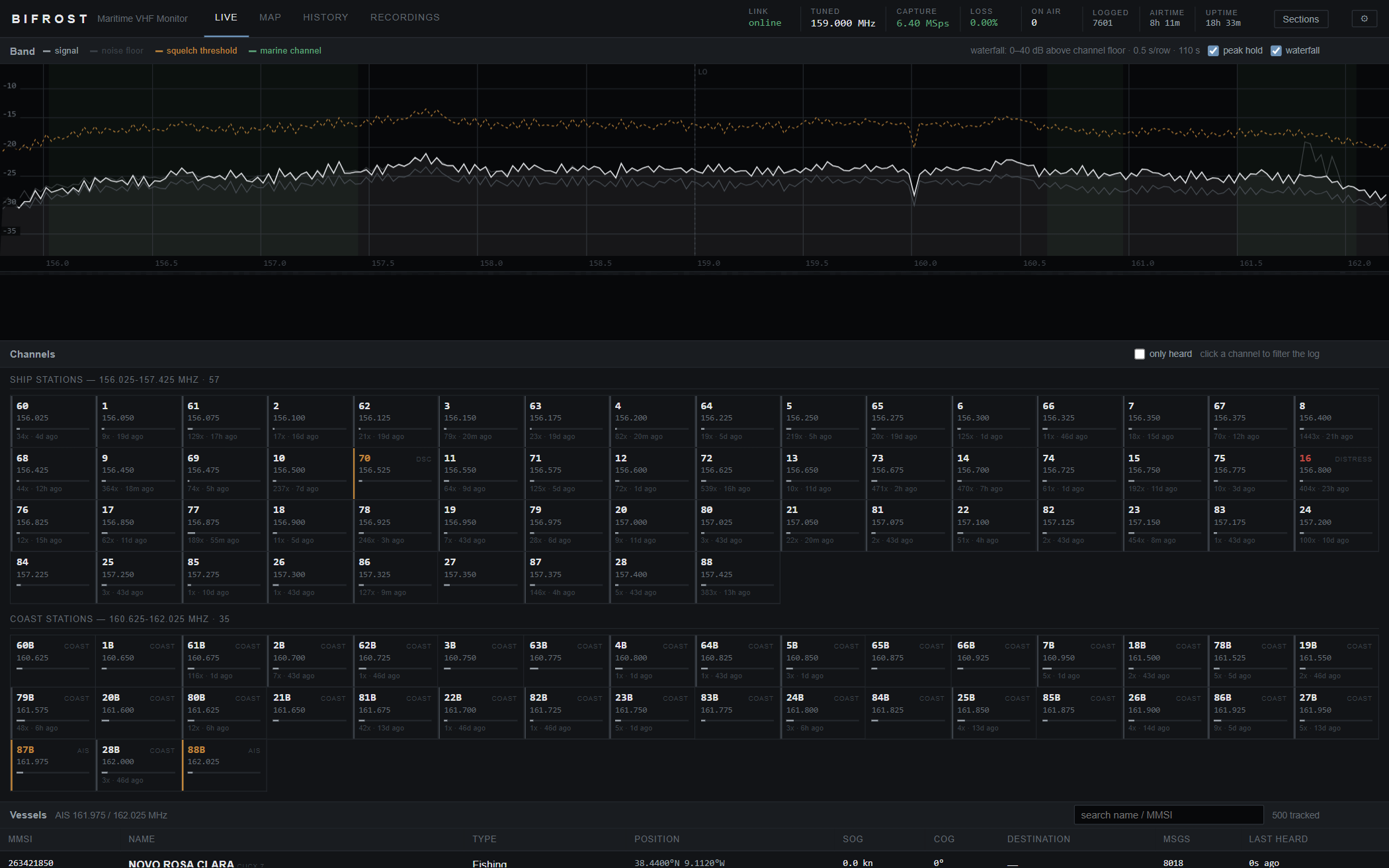
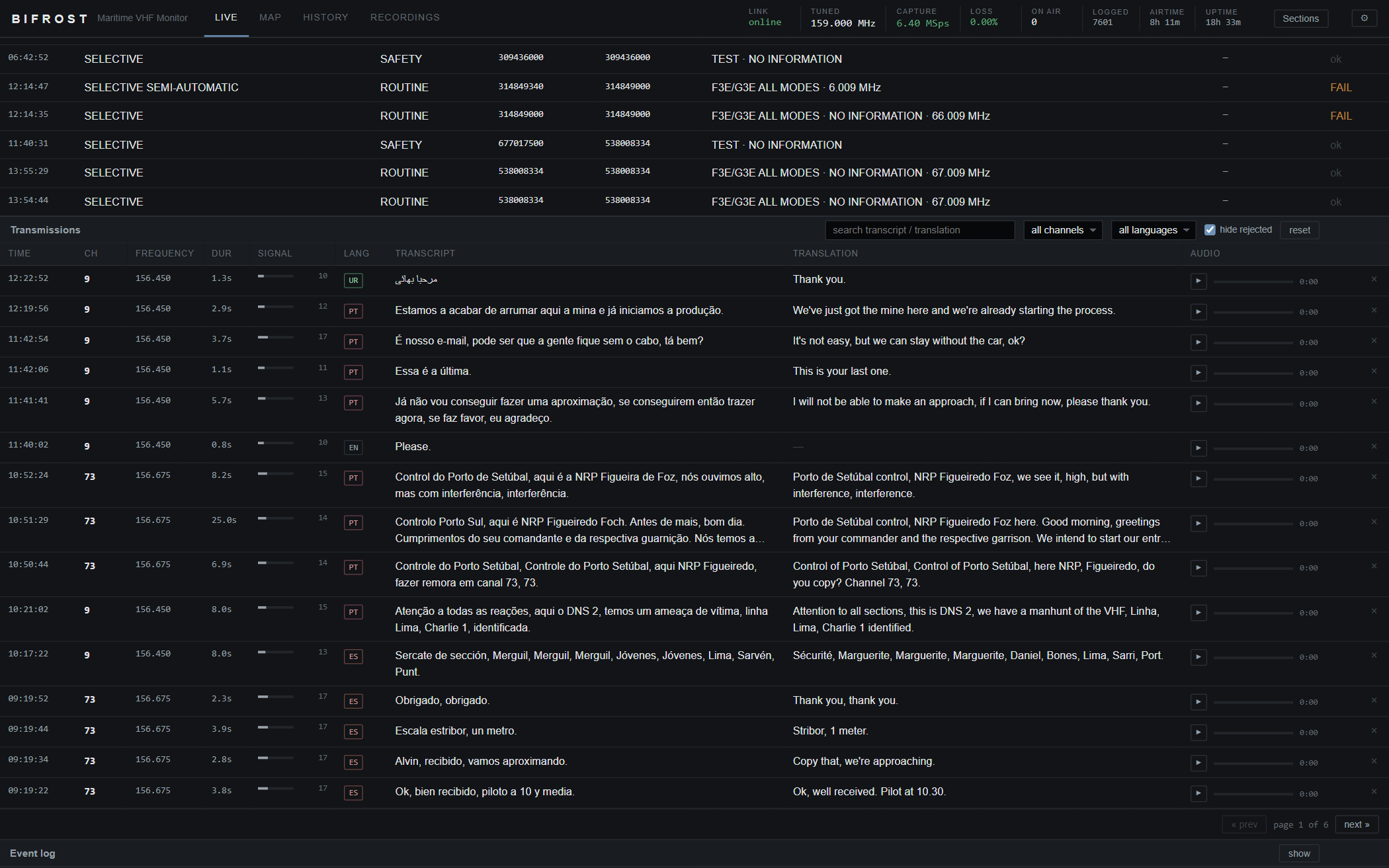
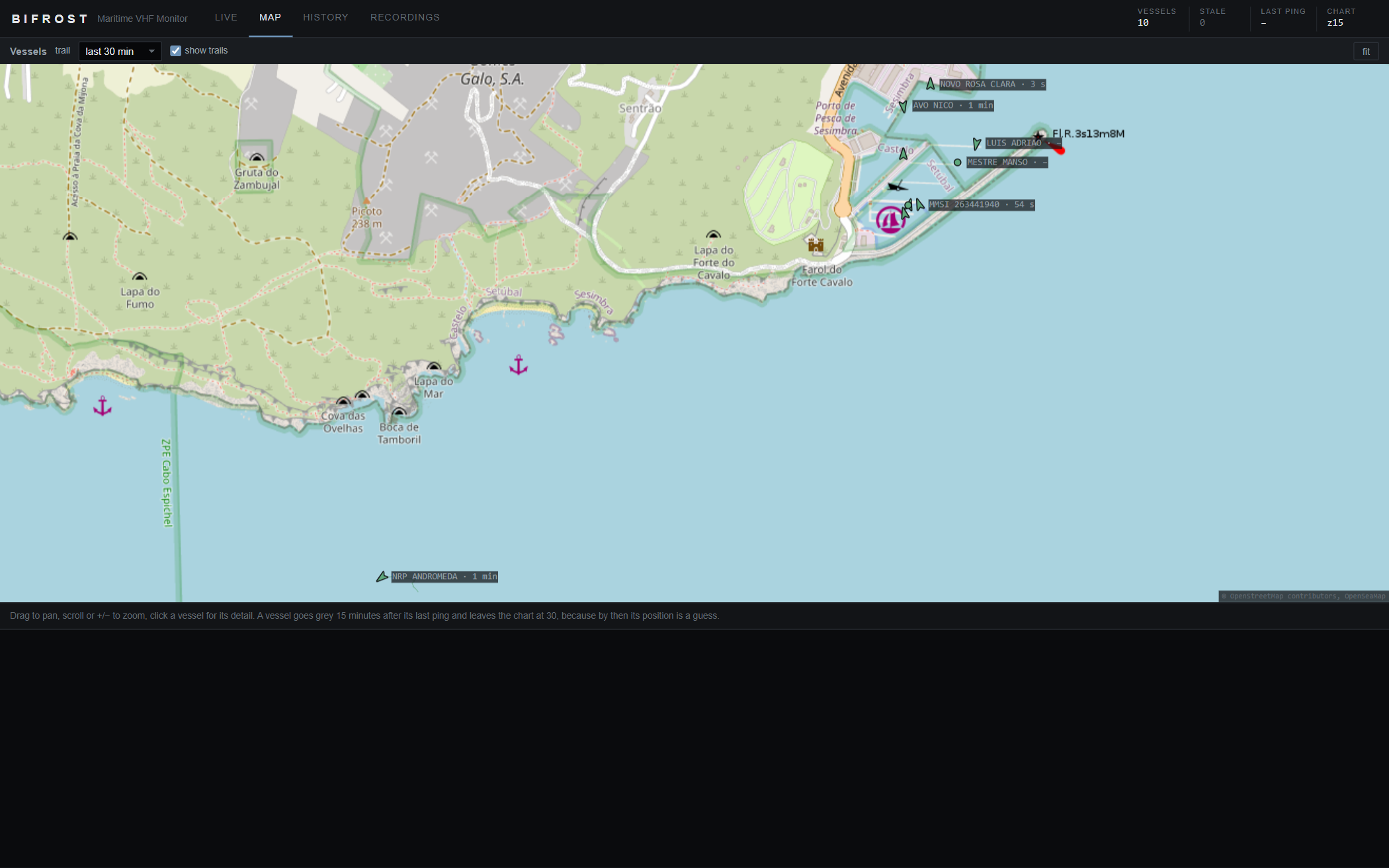
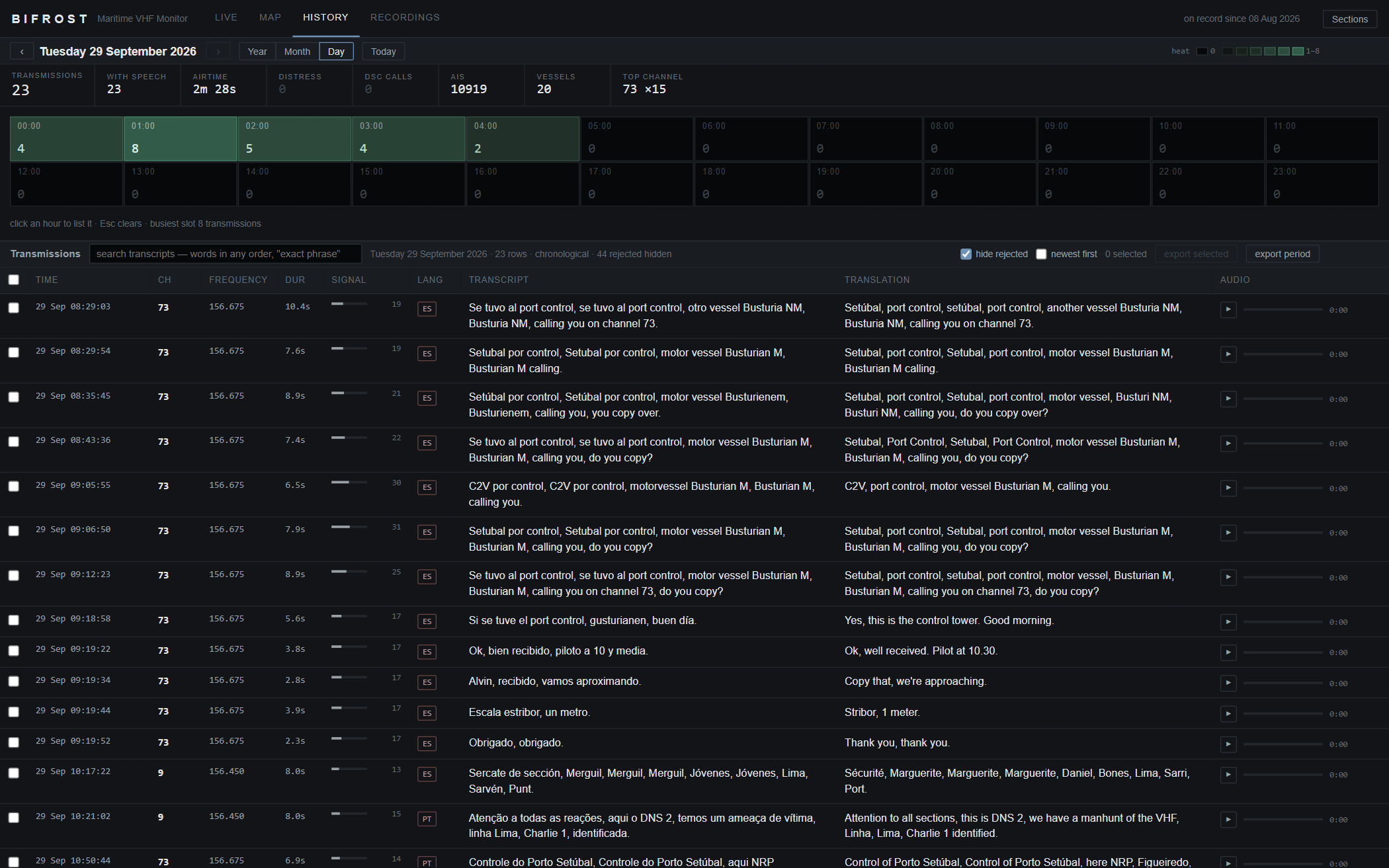
Tested at REPMUS 26 for 21 days
Bifrost ran for twenty-one days against live coalition and commercial traffic in the Sesimbra and Setúbal approaches during REPMUS 26, the NATO and Portuguese Navy robotic experimentation exercise.
“Sécurité, Sécurité, Sécurité, all stations, all stations, all stations. This is RIB Laguna, Laguna, Laguna. Underwater drone operations completing 100 metres south-west of my location, 38 degrees north, 25.370, 9 degrees west, 7.169. Unmanned vehicles surfacing shortly.”
Captured verbatim, with spoken position, 15 September 2026 at 09:09 UTC. One of roughly 22 navigational-safety broadcasts recorded in full during the exercise.
“Atenção a todas as estações, daqui DMS2, mergulho, mergulho, mergulho, Yankee, Charlie 1.”
→ “Attention all stations, from here DMS2, dive, dive, dive, Yankee Charlie 1.”
Divers entering the water, announced to all stations on channel 9 — captured, transcribed and translated unattended at 11:42 UTC on 29 September 2026, while the station was being assessed.
| Days with logged traffic | 21 |
|---|---|
| Transmissions logged | 7,115 |
| Transcribed · translated to English | 4,095 · 2,788 |
| Languages observed | 48 |
| Marine channels carrying speech | 33 |
| AIS vessels · messages | 561 · 865,492 |
| DSC calls decoded | 24, of which 22 passed the error check |
| Also captured | A French warship anchoring notification on channel 16, in French · an orca attack reported by a sailing vessel 4 nm south of Sesimbra · five diving-operations broadcasts |
What it heard, by language
49 languages appeared in real traffic over the corpus. The ten most common:
- English 1,367
- Portuguese 1,234
- German 379
- Russian 347
- Spanish 184
- Italian 146
- French 68
- Polish 63
- Greek 58
- Dutch 55
- + 39 more
Specification
What the station does and what it needs. Implementation detail is covered under NDA.
| Band covered | 155.80 – 162.20 MHz, marine VHF |
|---|---|
| Coverage method | Whole band at once — no scanning, no channel selection |
| Channels watched | 256 at 25 kHz · 92 ITU maritime channels |
| Per-channel detection | Independent squelch against each channel's own noise floor |
| Concurrent voice traffic | Multiple channels captured simultaneously |
| AIS | Both channels, same receiver, no extra hardware |
| DSC | Channel 70, error-check validated |
| Antenna | Standard marine VHF antenna |
| Compute | One commodity computer — no rack, no GPU server |
|---|---|
| Speech and translation | Run on the station · to English · 100 languages |
| Network dependency | None in the processing path |
| Audio retained | Every transmission, playable in the log |
| Time-shifted listening | Five-minute rolling buffer per channel, jump to live |
| Search | Full text across every transcript and translation |
| Export | ZIP of CSV, JSON and audio — 24 h in under 2 s |
| Operator interface | Web browser, pushed updates, no install |
| Deployment | Vessel, shore station or USV |
| Supply | Input | Idle | Typical, receiving and transcribing | Peak |
|---|---|---|---|---|
| 12 V DC | 11 – 16 V, vessel bus or battery | ~0.4 A · 5 W | 2.5 – 3.5 A · 30 – 40 W | < 5.5 A · 65 W |
| AC mains | 100 – 240 V, 50/60 Hz | ~5 W | 30 – 40 W | < 65 W |
Figures are the compute platform's rated draw plus the receiver front end, not yet measured on a running station — they are indicative and will be replaced with instrumented numbers. For scale: a 100 Ah house bank at the typical figure gives roughly 17 hours of continuous watch before it reaches half charge.
Where it is, and where it is not
Bifrost is offered as a monitoring, recording and exploitation tool. We publish what has been measured and name what has not, because a technical evaluator will ask.
What the evidence supports today
- The radio is production-grade. Zero lost samples across 432 billion, zero overflows, zero restarts.
- Roughly seven transcripts in ten are operationally useful — graded good or partial by blind scoring of a 240-transmission sample, corroborated by a separate 533-sample audit.
- Long, well-formed safety broadcasts are captured in full, including spoken positions, verbatim and unattended.
- AIS and DSC decoding are strong, with error-check validation on every DSC call.
What we do not claim
- Not a safety-of-life alerting product. Keyword alerting on distress traffic is not reliable yet and is not offered. Improving the language layer for maritime speech is the specific focus of current work.
- No word error rate is published, because none has been measured on this system. Figures quoted in older papers were a general model's marketing claim, not ours.
- No maritime-adapted speech model yet. The model is general purpose.
- Availability, end-to-end latency and receiver sensitivity are not yet instrumented. They are on the roadmap and will be published when measured.
Get in touch
Bifrost is built by Bifrost Thorware LLC, alongside CTRL ALT MINE DEL and BATHY CONVERTER. To get in touch or receive a demo, contact murphy@bifrostthorware.com.
murphy@bifrostthorware.com